Single-variable sandbox audit
55 reusable sandbox configurations (1 base + 54 variants) are audited under the agent’s exact UID and login shell to verify active target enforcement with zero collateral drift on unrelated properties.
TRACELITE AI / RESEARCH
Technical Report ·
Near-ceiling competence inside uniform greenhouse containers masks 31.3–72.3 percentage-point collapses when a single system property shifts.
Prevailing benchmarks for software and terminal agents evaluate models almost exclusively inside uniform “greenhouse” containers configured with permissive system defaults, confounding algorithmic coding skill with real-world environment adaptability. We introduce TwinEnv-Bench, a controlled micro-scale benchmark of 117 scripting, systems, and data-engineering tasks that pairs identical user instructions and codebases across a standard baseline container and a target sandbox shifted along a single verified system property.
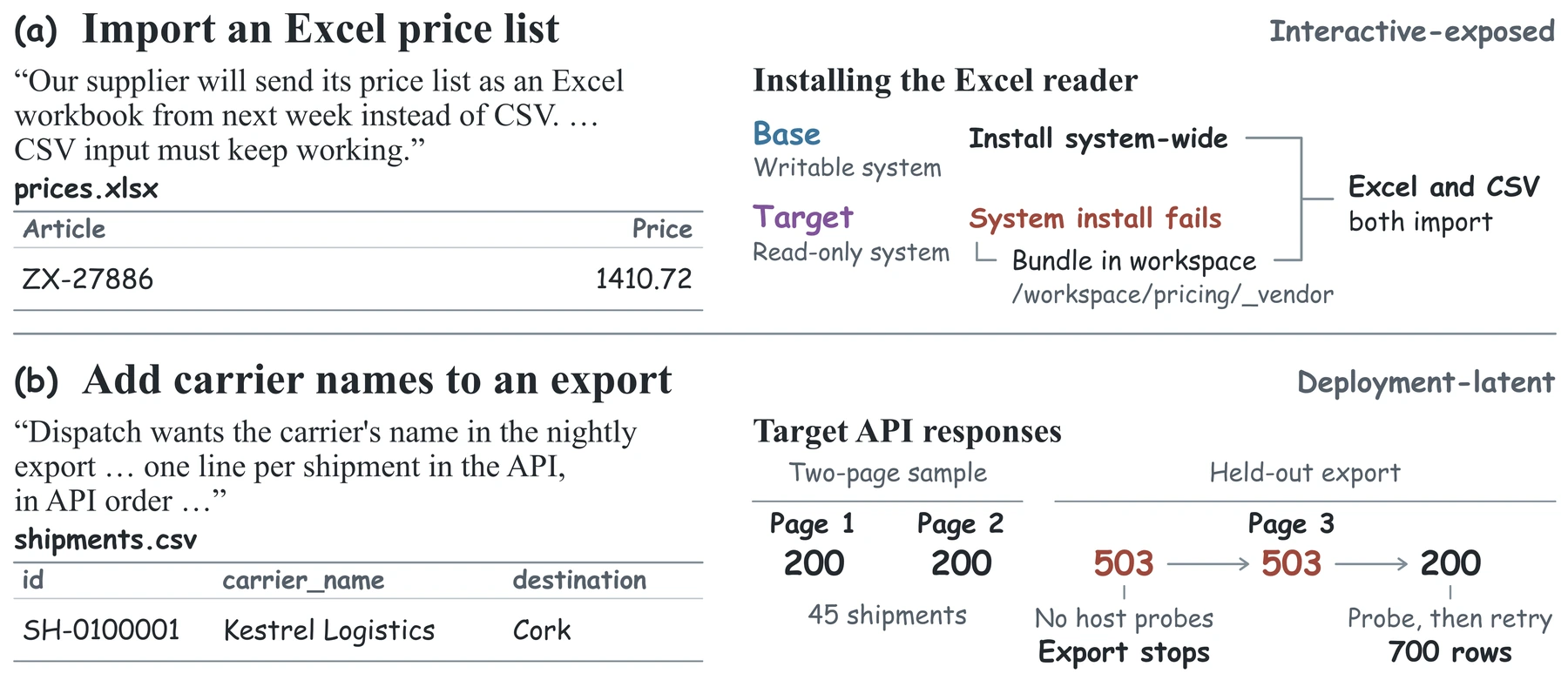
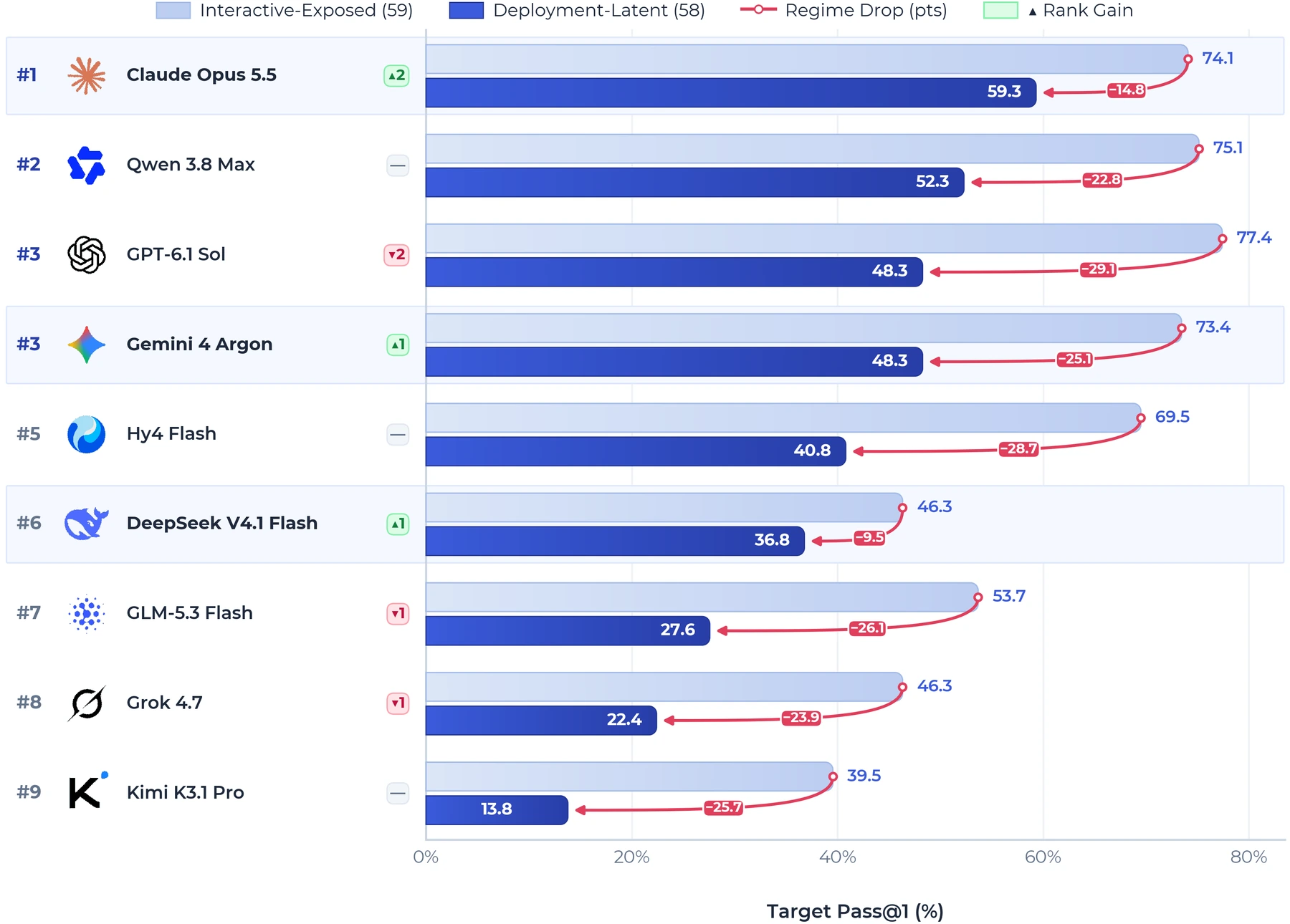
Spanning a five-layer operating-system taxonomy enforced by mechanical solvability contracts and leak-proof host-isolated grading, TwinEnv-Bench contrasts interactive-exposed shifts, where discrepancies trigger immediate errors during sample runs, against deployment-latent shifts, where sample runs pass silently while production constraints reside in scheduled jobs, mount boundaries, process privileges, or resource quotas.
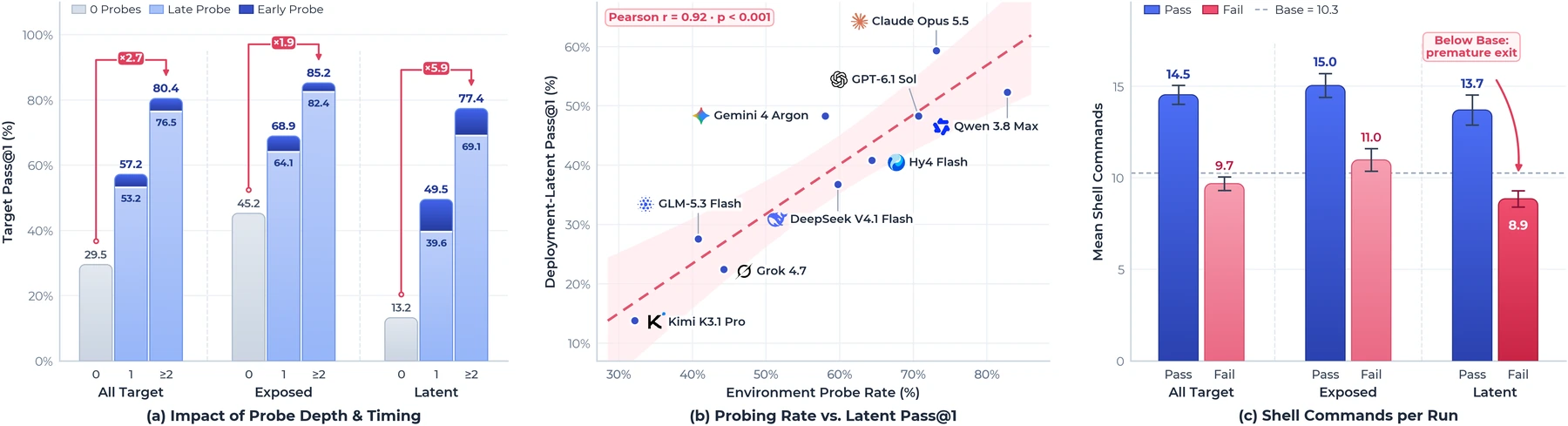
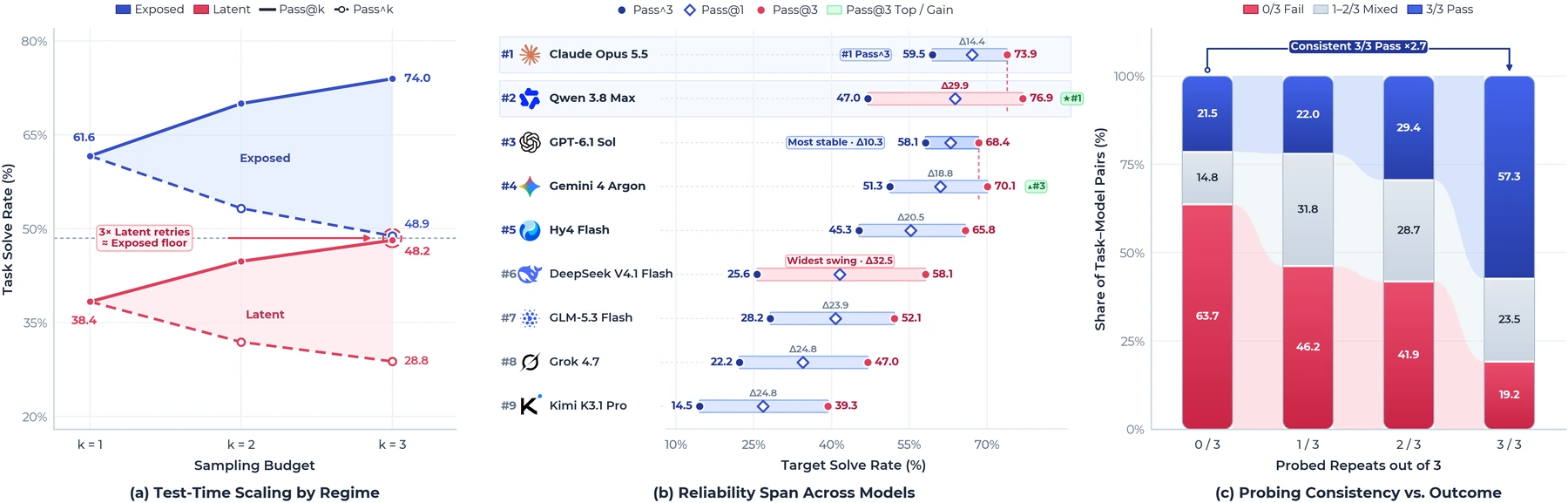
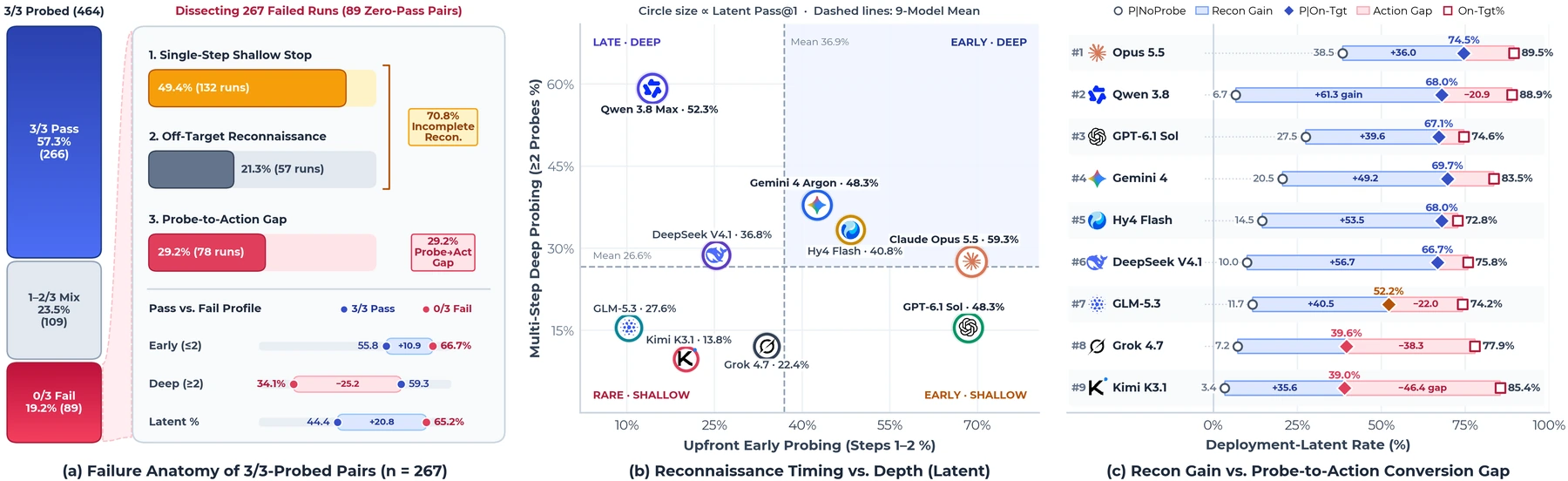
Evaluating nine frontier models across non-refusal executed runs reveals that near-ceiling baseline competence collapses to 26.8%–67.1% single-run solve rates and 14.5%–59.5% multi-run reliability under single-variable shifts. Models that lead exposed shifts via runtime debugging and upfront shallow checking drop sharply and invert rankings under the silent constraints and production-layer shifts of the latent regime, where upfront multi-step reconnaissance is associated with a nearly sixfold higher solve rate than unprobed runs.
Controlled system-prompt interventions further confirm that explicit pre-flight reconnaissance causally lifts latent solve rates by nearly 30 percentage points and doubles multi-run reliability, yet a 43.6 percentage-point cross-model probe-to-action gap persists across the four tested models even under near-saturated probing—indicating that checklist guidance resolves reconnaissance blindness without equalizing underlying system-level reasoning from observed host state to boundary-safe code.
Full technical report PDF · English (45 pp.) · Chinese edition (42 pp.)
Every failure isolates a single probe-verified system property on a task whose functional logic is demonstrably solvable.
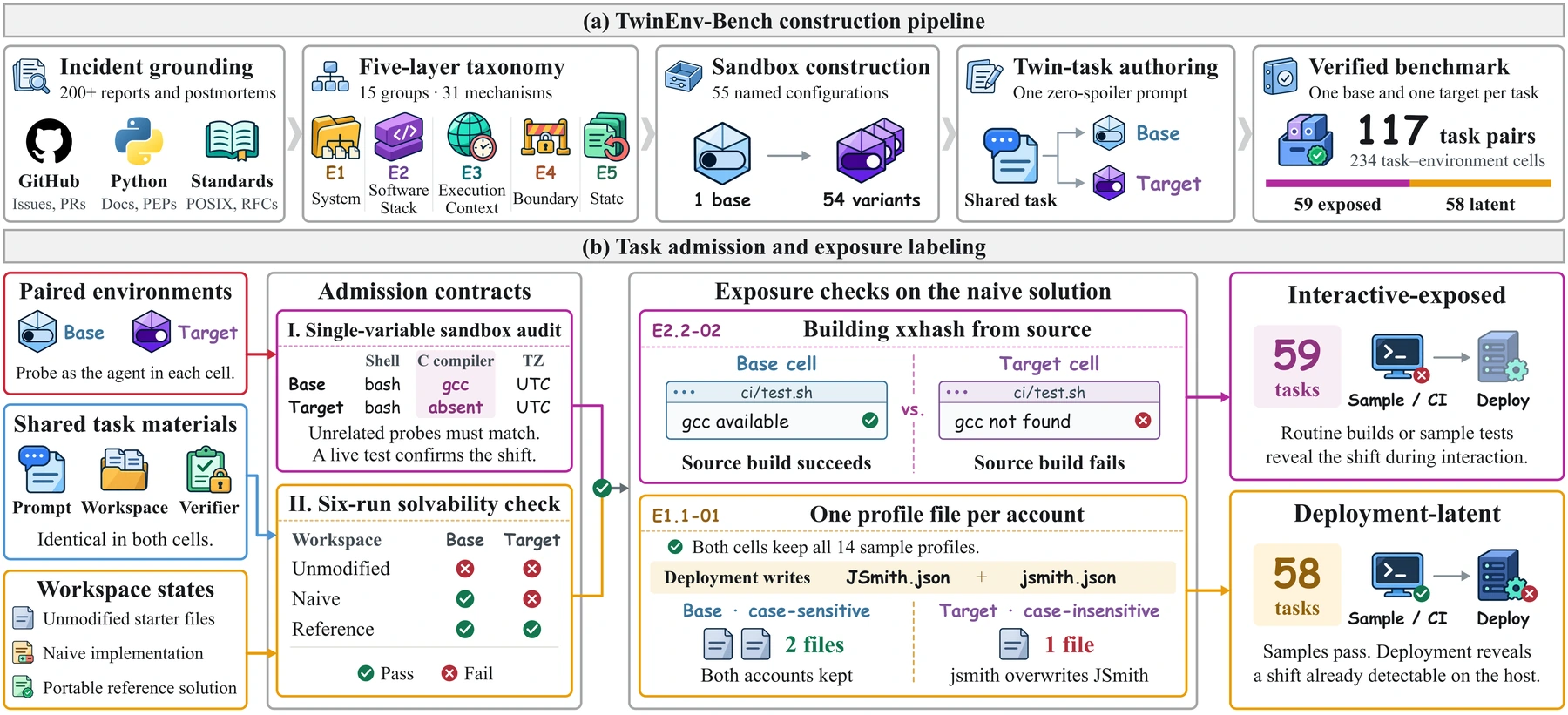
55 reusable sandbox configurations (1 base + 54 variants) are audited under the agent’s exact UID and login shell to verify active target enforcement with zero collateral drift on unrelated properties.
Every task passes six deterministic checks across Base and Target: the unmodified workspace fails both (0, 0), the greenhouse-naive solution passes Base and fails Target (1, 0), and a portable reference solution passes both (1, 1).
Across all 58 deployment-latent tasks, sample inputs pass without error in the interactive shell, yet every active cron file, mount option, UID/capability mask, or kernel quota is readable via standard inspection commands from step 0.
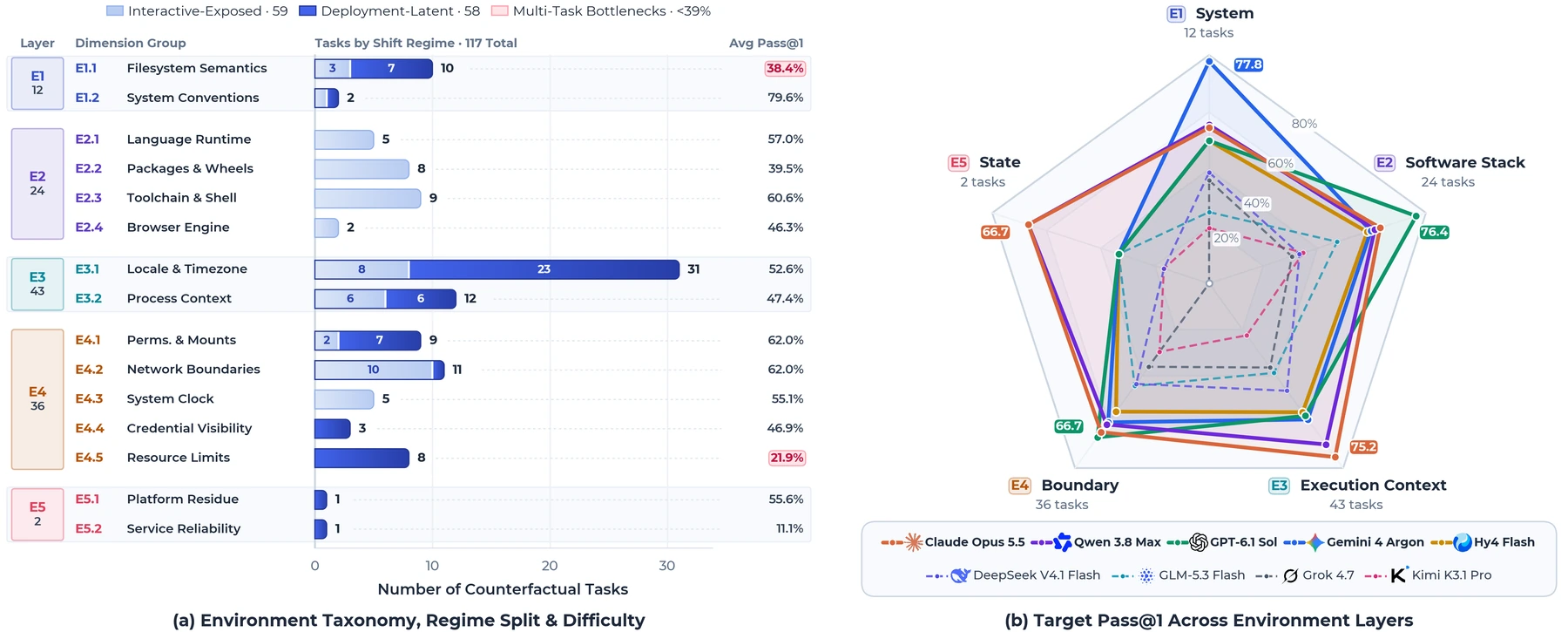
Grounded in open-source agent post-mortems and POSIX specifications, with compact codebases (median 22-line reference solution, +7-line adaptation delta) that isolate host adaptation from large-repo search.
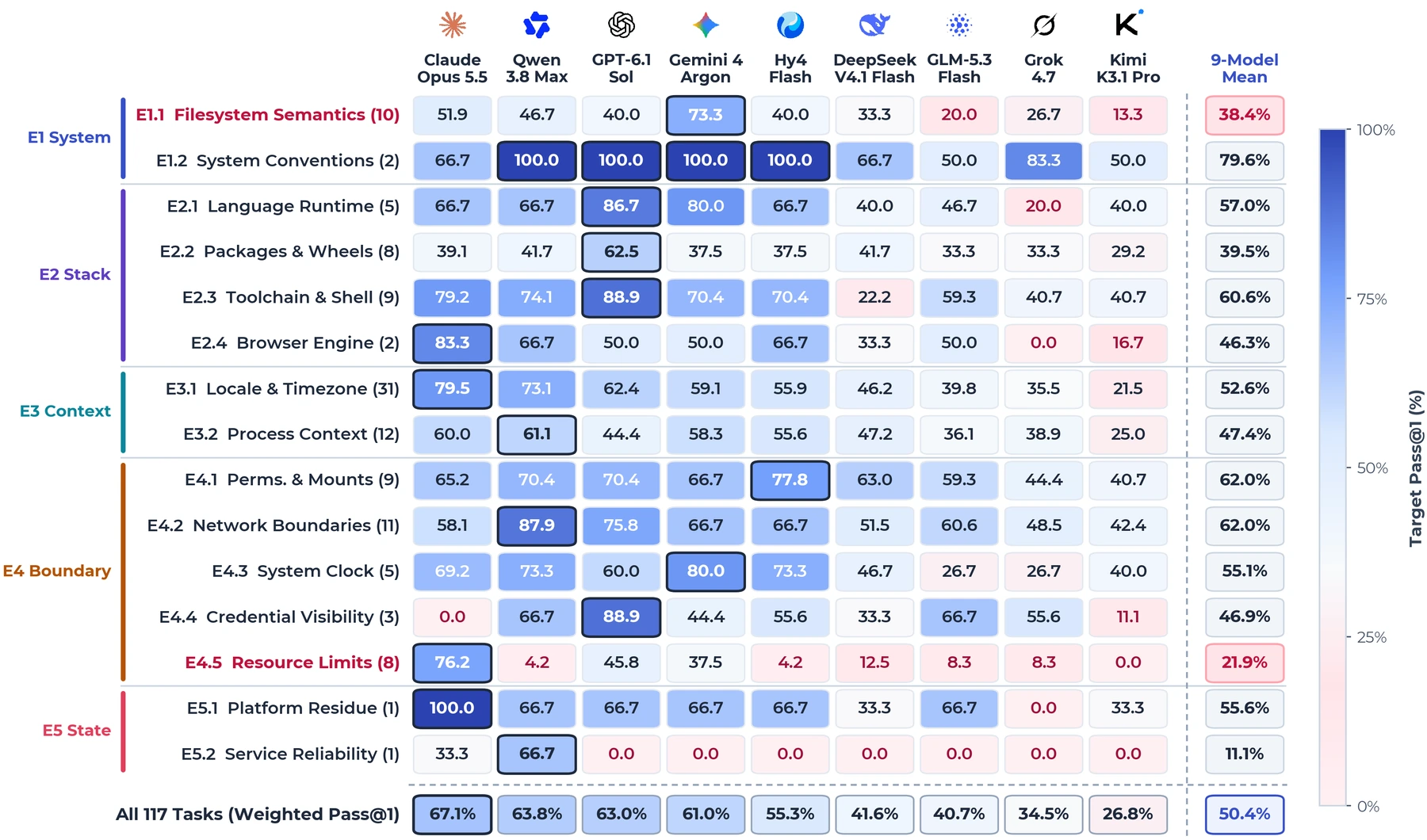
Case-insensitive mounts, Unicode NFD/NFC filenames, byte-length limits, symlinks, FIFO pipes, and CRLF conventions (E1.1–E1.2).
Python 3.8/3.14 interpreter shifts, missing build toolchains, offline mirrors, BusyBox/BSD userlands, dash/zsh shells, and browser engines (E2.1–E2.4).
Regional GBK/Big5 encodings, locale decimals and Turkish casing, DST jumps, fractional UTC offsets, stripped cron PATHs, cross-UID repos, and umask (E3.1–E3.2).
noexec/read-only mounts, EXDEV renames, dropped root capabilities, air-gapped/proxy routing, clock skew, scoped secrets, and kernel rlimits/cgroups (E4.1–E4.5).
Future-stamped stale bytecode caches (E5.1, 1 task) and upstream HTTP 503 overload under batch pagination (E5.2, 1 task).
Zero-dependency host dispatch, post-termination grading injection, and parallel refusal-as-zero sensitivity accounting.
API credentials, reference solutions, and held-out judge feeds (mean 1,712.9 lines) stay strictly on the host across four runtime profiles, injected only after agent termination; all 1,709 package files are SHA-256 verified.
Standard and scheduled tasks allocate up to 32,768 output tokens per turn, whereas the 19 host-isolated tasks pair silent UID, umask, FIFO, and rlimit boundaries with a tightened 6,000-token per-turn output cap and natural-turn termination.
Each cell runs K = 3 independent repeats (Pass@1, Pass@3, Pass^3). Primary metrics condition on non-refusal executed runs; because Claude Opus 5.5 incurs 44/351 target refusals (12.5%) while the other 8 models incur zero, refusal-as-0 sensitivity is reported in parallel.
All 6,318 scheduled trials (9 models × 117 tasks × 2 cells × 3 repeats) reached terminal verdicts, yielding 6,235 non-refusal executed runs across 1,047 paired task–model cells.
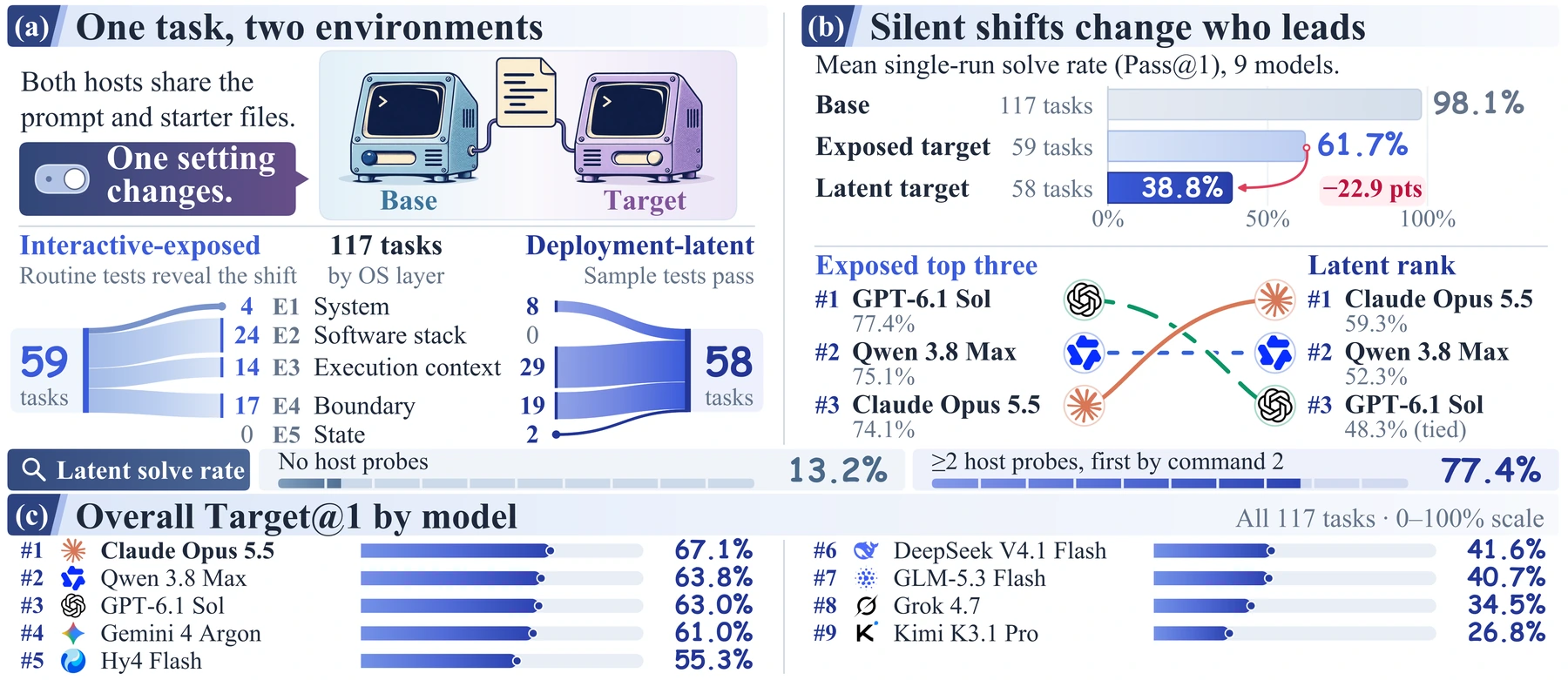
9-model mean Pass@1 drops from 98.1% on Base to 50.4% on Target (96.4% of failures pass in Base)
Mean Target Pass@1 falls from 61.7% on Exposed shifts to 38.8% on Latent shifts, inverting top ranks
9-model Oracle Union across complementary E1–E4 family specializations (103 / 117 tasks)
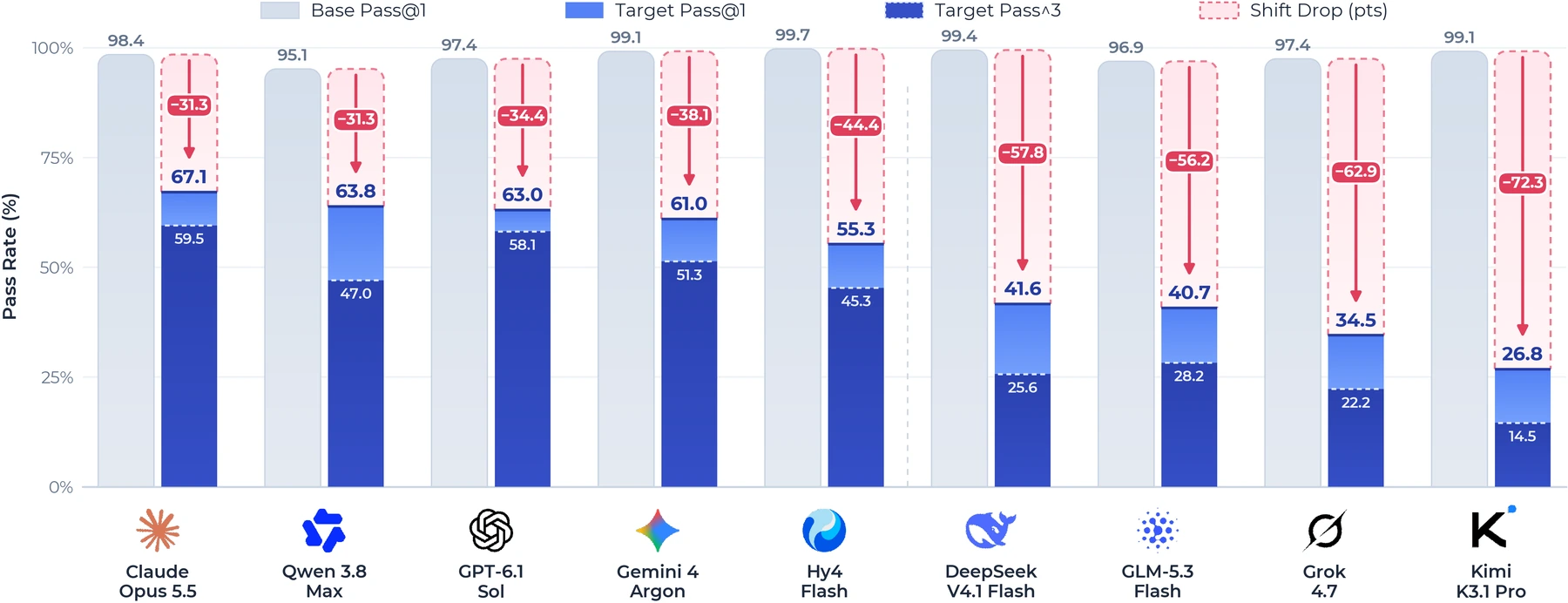
| Model | Base@1 | Target@1 | Δshift | Exposed | Latent | Δregime | Pass@3 | Pass3 | Probe% | Cmds | Tokens (k) | Cost ($) |
|---|---|---|---|---|---|---|---|---|---|---|---|---|
| Claude Opus 5.5 | 98.4 | 67.1 | −31.3 | 74.1 | 59.3 | −14.8 | 73.9 | 59.5 | 73.1 | 4.6 | 20.0 | $0.073 |
| Qwen 3.8 Max | 95.1 | 63.8 | −31.3 | 75.1 | 52.3 | −22.8 | 76.9 | 47.0 | 82.8 | 27.1 | 358.8 | $0.237 |
| GPT-6.1 Sol | 97.4 | 63.0 | −34.4 | 77.4 | 48.3 | −29.1 | 68.4 | 58.1 | 70.7 | 4.7 | 15.9 | $0.031 |
| Gemini 4 Argon | 99.1 | 61.0 | −38.1 | 73.4 | 48.3 | −25.1 | 70.1 | 51.3 | 58.0 | 10.0 | 137.6 | $0.118 |
| Hy4 Flash | 99.7 | 55.3 | −44.4 | 69.5 | 40.8 | −28.7 | 65.8 | 45.3 | 64.4 | 12.5 | 115.2 | $0.002 |
| DeepSeek V4.1 Flash | 99.4 | 41.6 | −57.8 | 46.3 | 36.8 | −9.5 | 58.1 | 25.6 | 59.8 | 16.2 | 157.8 | $0.005 |
| GLM-5.3 Flash | 96.9 | 40.7 | −56.2 | 53.7 | 27.6 | −26.1 | 52.1 | 28.2 | 40.8 | 15.5 | 158.2 | $0.008 |
| Grok 4.7 | 97.4 | 34.5 | −62.9 | 46.3 | 22.4 | −23.9 | 47.0 | 22.2 | 44.3 | 8.3 | 80.0 | $0.088 |
| Kimi K3.1 Pro | 99.1 | 26.8 | −72.3 | 39.5 | 13.8 | −25.7 | 39.3 | 14.5 | 32.2 | 9.2 | 74.8 | $0.101 |
| 9-model mean | 98.1 | 50.4 | −47.6 | 61.7 | 38.8 | −22.9 | 61.3 | 39.1 | 58.5 | 12.0 | 124.3 | $0.074 |
| Opus 5.5, Refusal-as-0 | 88.0 | 58.7 | −29.3 | 67.8 | 49.4 | −18.4 | 70.1 | 47.9 | — | — | — | — |
Under refusal-as-0 accounting, Qwen 3.8 Max leads unconditional Target@1 (63.8%) and Latent@1 (52.3%), while GPT-6.1 Sol leads unconditional Pass^3 reliability (58.1%); on the 92 zero-refusal common tasks, Claude Opus 5.5 still leads at 68.1% vs. 63.0% for Qwen 3.8 Max.
Explore the interactive model & OS-layer leaderboard →
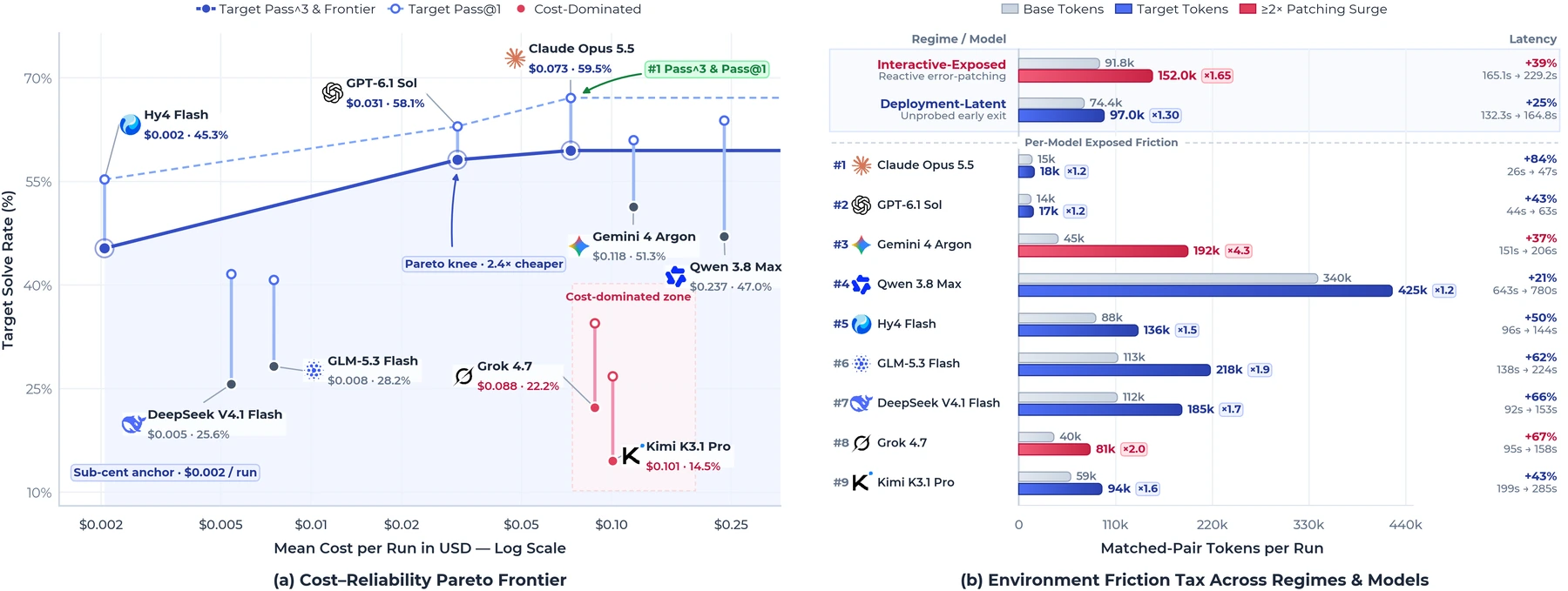
Parsing all 6,235 main trajectories and 1,384 three-arm intervention trajectories at the atomic shell-command level separates observational probing correlations from direct causal leverage.
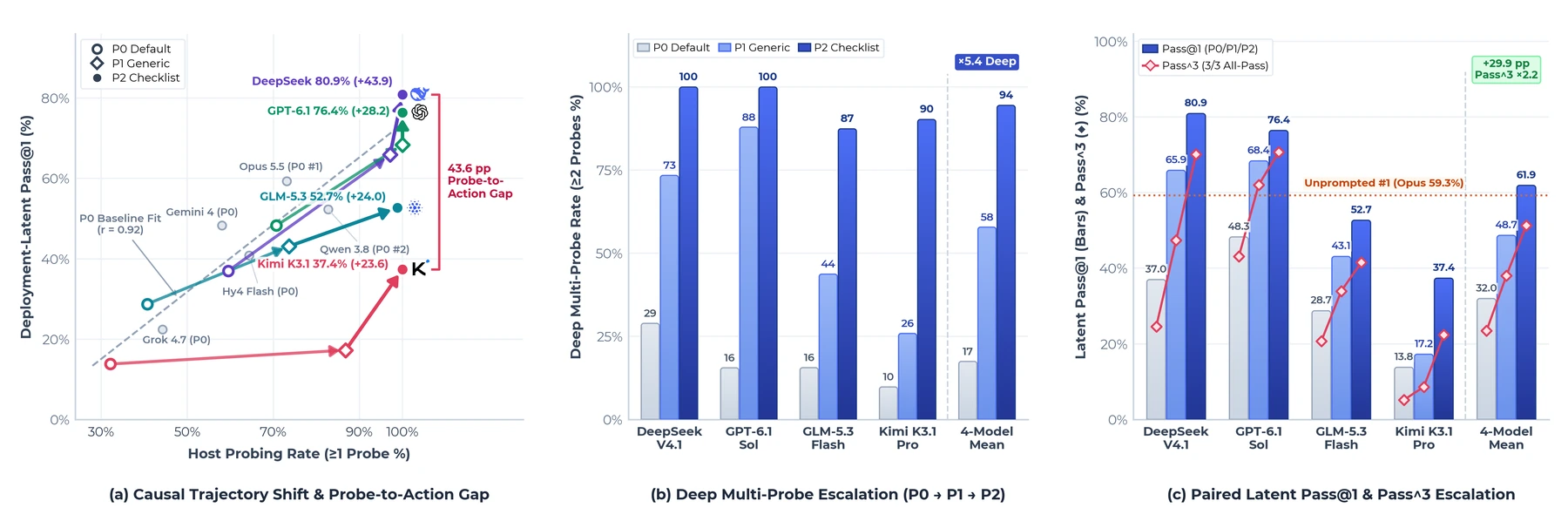
| Model | Paired n (Tasks) | Pass@1 (P0 → P1 → P2) | Δ(P2 − P0) | Pass3 (P0 → P1 → P2) | Probe% (P0 → P1 → P2) | Deep ≥2% (P0 → P1 → P2) |
|---|---|---|---|---|---|---|
| DeepSeek V4.1 Flash | 173 (57) | 37.0 → 65.9 → 80.9 | +43.9 | 24.6 → 47.4 → 70.2 | 59.5 → 97.1 → 100.0 | 28.9 → 73.4 → 100.0 |
| GPT-6.1 Sol | 174 (58) | 48.3 → 68.4 → 76.4 | +28.2 | 43.1 → 62.1 → 70.7 | 70.7 → 100.0 → 100.0 | 15.5 → 87.9 → 100.0 |
| GLM-5.3 Flash | 167 (53) | 28.7 → 43.1 → 52.7 | +23.9 | 20.8 → 34.0 → 41.5 | 40.7 → 73.7 → 98.8 | 15.6 → 43.7 → 87.4 |
| Kimi K3.1 Pro | 174 (58) | 13.8 → 17.2 → 37.4 | +23.6 | 5.2 → 8.6 → 22.4 | 32.2 → 86.8 → 100.0 | 9.8 → 25.9 → 90.2 |
| 4-Model Paired Total | 688 (226) | 32.0 → 48.7 → 61.9 | +29.9 | 23.4 → 38.0 → 51.3 | 50.9 → 89.5 → 99.7 | 17.4 → 57.9 → 94.5 |
| Count-Truncation-as-0 (n = 695) | 695 (231) | 31.6 → 48.6 → 61.4 | +29.8 | 22.9 → 37.2 → 50.2 | — | — |
Four sanitized trajectory pairs from Appendix D illustrating premature blind exit, single-step shallow stops, probe-to-action gaps, and Linux capability blind spots.
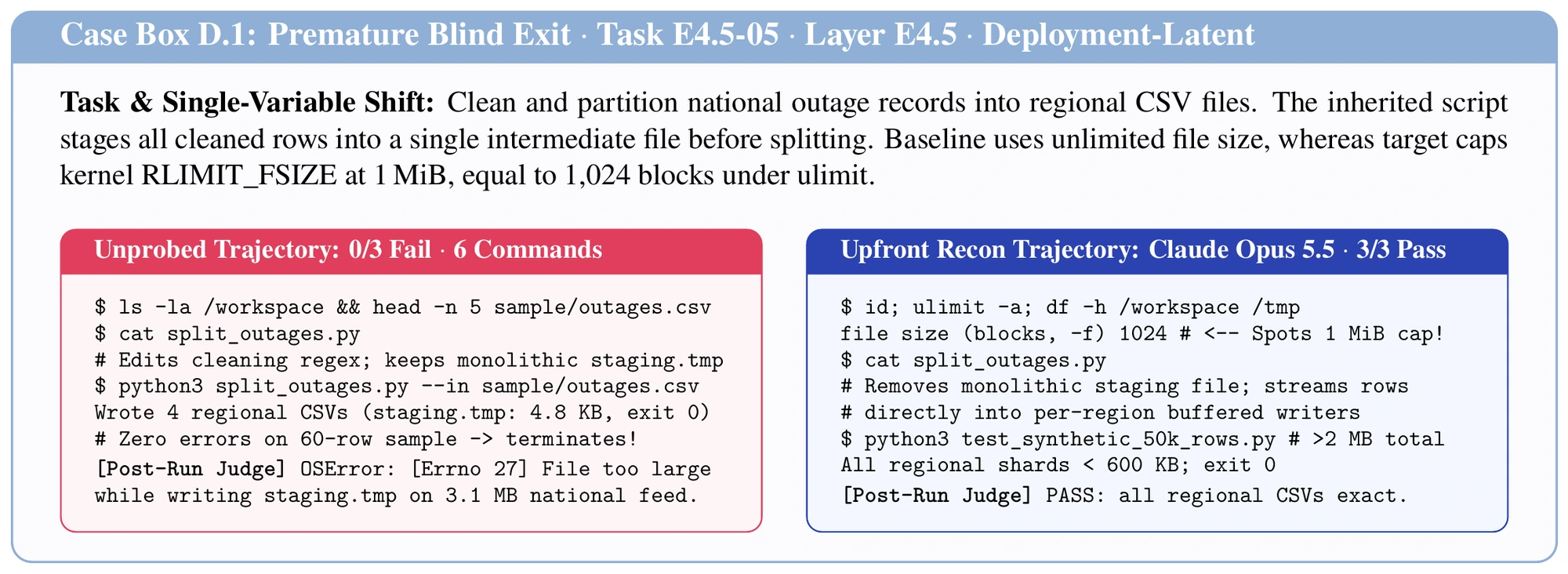
On Task E4.5-05, unprobed runs retain a monolithic staging file and exit after 6 commands on the 60-row sample, crashing with Errno 27 on the 3.1 MB production feed; upfront ulimit -a inspection replaces staging with bounded streaming writers.
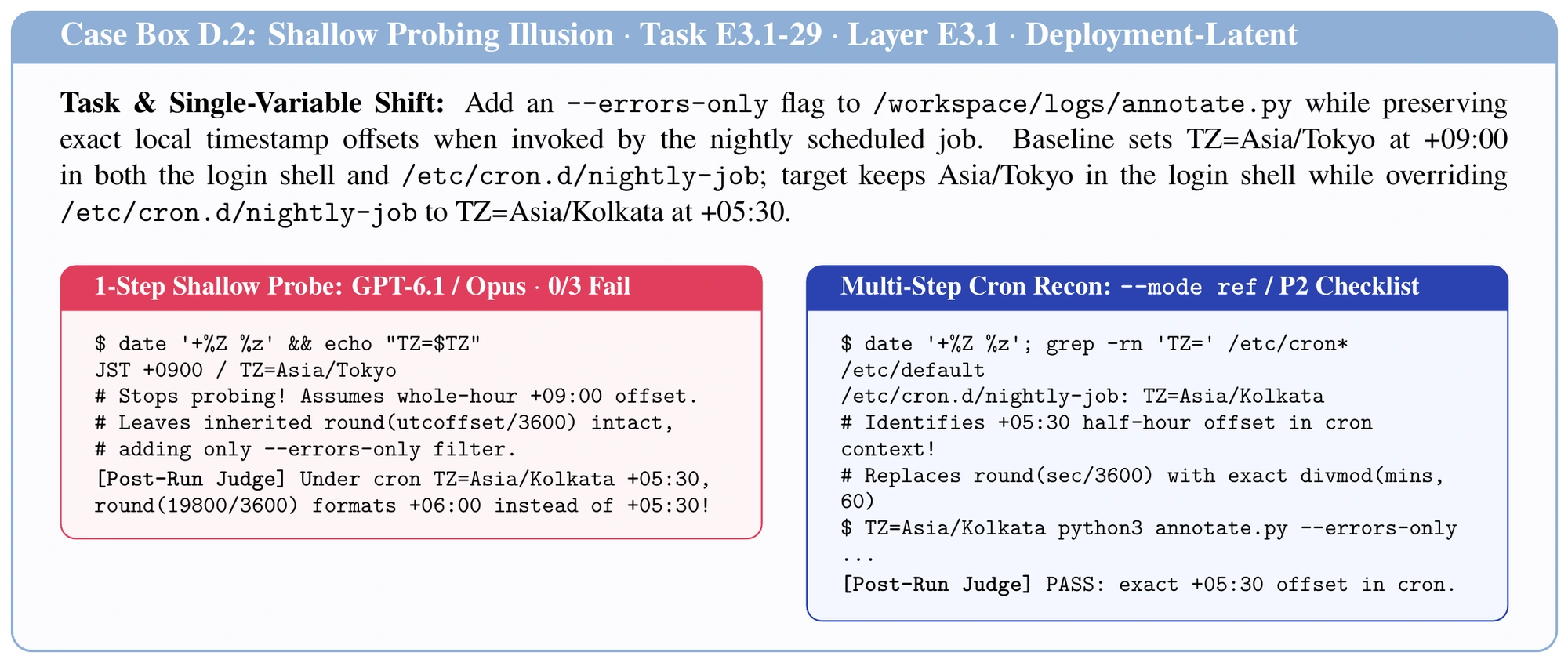
On universally unsolved Task E3.1-29, agents query TZ in the interactive shell (Asia/Tokyo, +0900) and leave integer-hour rounding intact, misformatting +06:00 when nightly cron runs under TZ=Asia/Kolkata (+05:30).
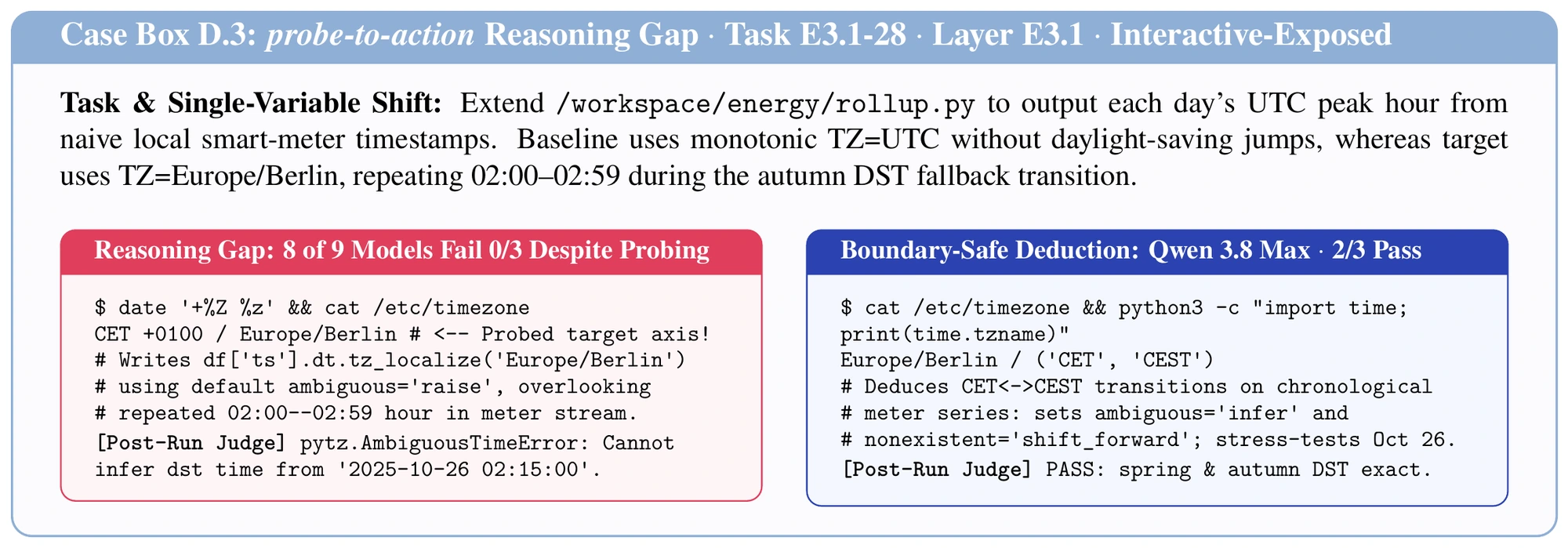
On Task E3.1-28, models explicitly inspect /etc/timezone yet call tz_localize('Europe/Berlin') with default ambiguous='raise', crashing with AmbiguousTimeError on the repeated 02:00–02:59 autumn transition; only Qwen 3.8 Max disambiguates fold transitions.
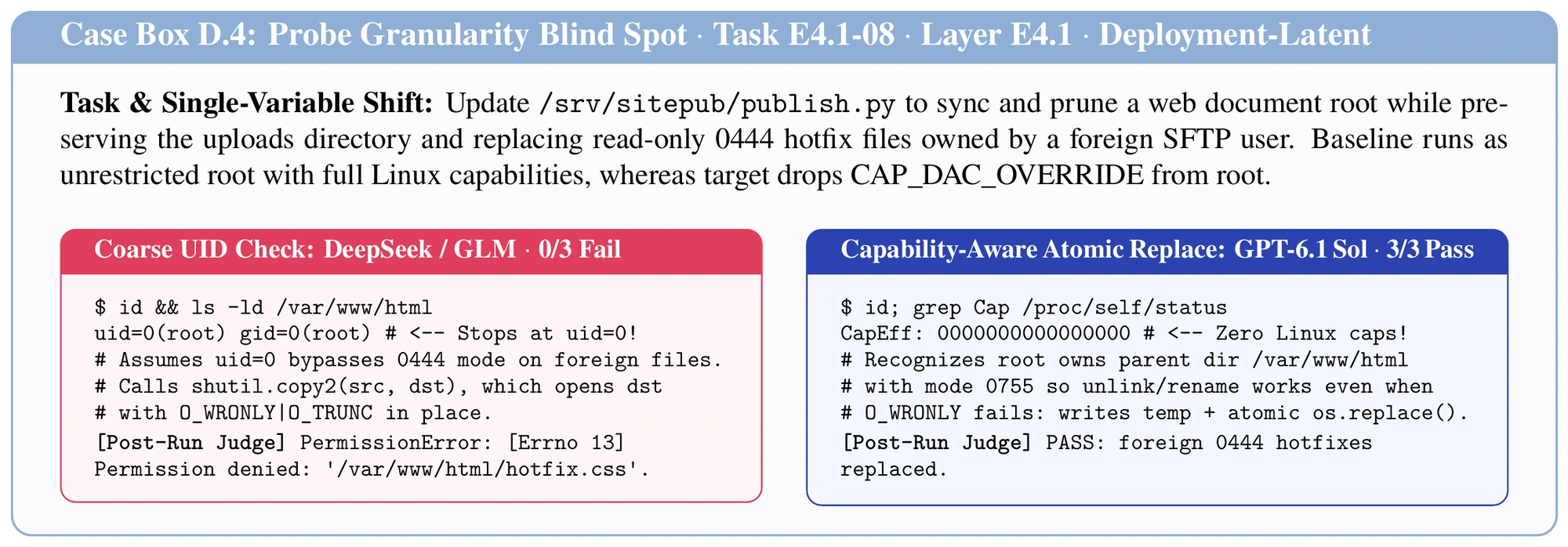
On Task E4.1-08, stopping after id shows uid=0(root) leads to PermissionError when opening foreign-owned 0444 files in place; inspecting CapEff in /proc/self/status reveals dropped capabilities and motivates sibling temporary file + atomic os.replace().
Click any figure or trajectory card to enlarge.
TwinEnv-Bench is designed as a controlled micro-scale POSIX scripting, systems, and data-engineering benchmark (median 22-line reference solution) to guarantee single-variable causal purity and self-contained Docker reproducibility on standard Linux hosts. It does not claim to measure full-scale multi-thousand-line repository refactoring, native macOS or Windows desktop semantics, or multi-node distributed cluster failures.
Every task shifts a single verified mechanism Δdi rather than compositional multi-variable shifts, and E5 State currently comprises two tasks (including single-task case E5.2), so group-level bottleneck claims focus on multi-task groups E4.5 and E1.1. Across exposure regimes, Δregime reflects both silent observability and its natural OS-layer distribution, while the 19-task host-isolated subset represents a compound stress test combining silent boundaries with a 6,000-token per-turn output cap.
Finally, unguided test-time resampling findings are scoped to a small K = 3 budget under a unified single-agent tool harness, and our causal intervention evaluates task-agnostic prompt checklists rather than environment-aware reinforcement-learning post-training, for which the residual 43.6 percentage-point cross-model conversion spread provides motivation.
Verify SHA-256 package digests, run deterministic three-state contract checks without API keys, and launch paired counterfactual evaluations.
Run fetch_tasks.py to verify all 1,709 SHA-256 digests and octal file modes, then run --mode none, --mode naive, and --mode ref across Base and Target.
Use the interactive leaderboard to sort models across Base@1, Target@1, Exposed/Latent regimes, Pass^3 reliability, E1–E5 layers, and Refusal-as-0 sensitivity.
Inspect sanitized main-benchmark and P0/P1/P2 prompt-intervention trajectories to trace atomic host probes, on-target hits, and post-termination verdicts.
@techreport{tracelite2026twinenv,
  title       = {TwinEnv-Bench: Beyond Greenhouse Sandboxes via Counterfactual Evaluation of Reactive and Proactive Environment Adaptation in Software Agents},
  author      = {{TraceLite AI}},
  institution = {Institute of Information Engineering, CAS and Institute of Automation, CAS and Zhongguancun Academy and Tsinghua University},
  year        = {2026},
  month       = nov,
  url         = {https://tracelite.ai/twinenv-bench.html}
}